
Mines Multiplier Chart: All Odds & Payouts Simply Explained
Mines on Shuffle pays according to one fixed formula, and every multiplier in the game comes from it: payout = 0.99 × C(25, gems) ÷ C(25 − mines, gems). That 0.99 is the game's 99% RTP (return to player) — a 1% house edge on every setup, whether you play 1 mine or 24.
This guide lays out the complete multiplier chart for the Mines gambling game on Shuffle, broken down by the mine counts players actually use, with the odds of reaching each multiplier shown alongside. If you want to know exactly what a given number of safe picks pays — and how likely you are to get there — every answer is below.
Key Takeaways
Mines is played on a 5×5 grid of 25 tiles. You choose between 1 and 24 mines before betting; the rest of the tiles hide gems.
Every multiplier is set by the formula 0.99 × C(25, gems) ÷ C(25 − mines, gems). Nothing is arbitrary, and every setup returns 99% RTP.
The maximum payout is 5,148,297×, reached by clearing 13 gems on 12 mines (or 12 gems on 13 mines).
The highest single-pick multiplier is 24.75×: one safe tile at 24 mines.
More mines means higher multipliers and lower survival odds.
Keep reading for the complete Mines payout table showing both sides of that trade, with every multiplier for every mine count from a single mine to the full 24.
How Are Mines Multipliers Calculated?
Every Mines multiplier is the fair odds of your picks succeeding, multiplied by 0.99. In standard mathematical notation, the formula looks like this:
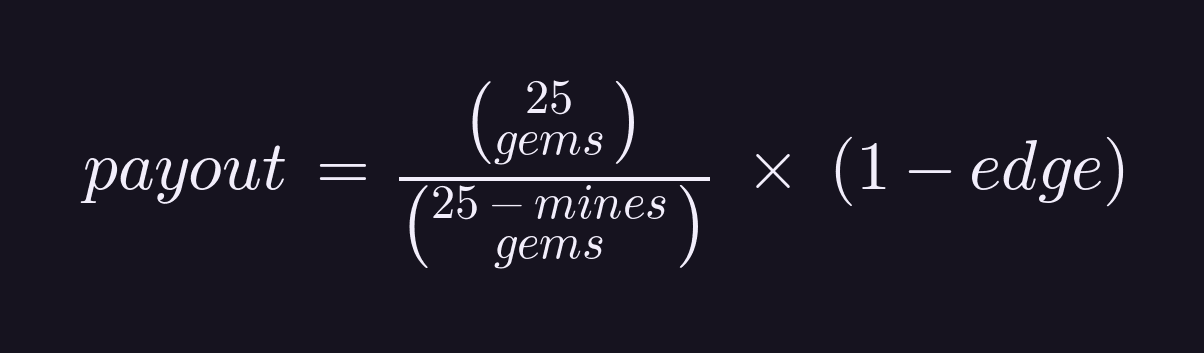
The C(n, r) notation used elsewhere on this page means the same thing — "combinations" — the number of ways to choose r tiles from n. C(25, gems) counts every possible set of tiles you could pick on the full grid; C(25 − mines, gems) counts only the sets that avoid every mine. Divide the first by the second and you get the true odds against you. Multiply by 0.99 and you get the payout.
In plain English: your payout is the game's 99% return divided by the probability of getting as far as you did. Rare outcomes pay proportionally more — that's the whole system — and the combinatorics above are just the machinery for counting exactly how rare each outcome is. One definition matters here: "gems" in the formula means gems revealed so far this round, not the total on the board. That's why the multiplier updates after every successful pick — each new reveal makes your current position one step less probable, so the formula pays one step more for it.
Here is a worked example. Say you set 3 mines and reveal 4 gems:
C(25, 4) = 12,650 — all the ways to pick 4 tiles from 25.
C(22, 4) = 7,315 — the ways to pick 4 tiles from the 22 safe ones.
12,650 ÷ 7,315 = 1.7293 — the fair odds.
1.7293 × 0.99 = 1.71× — the multiplier you'll see in the game.
You can run this check on any cell in the chart. Because Mines is a Provably Fair Shuffle Original, the tile layout itself is also verifiable after every round using the game's cryptographic seed and nonce — the Provably Fair guide walks through exactly how — so both the math and the outcomes are open to inspection.
Multiplier Chart: 1 Mine
One mine is the gentlest setup: 24 of the 25 tiles are safe, multipliers grow slowly, and clearing the entire board pays 24.75×. The "chance" column shows your probability of revealing that many gems without hitting the mine.
Gems revealed | Multiplier | Chance of reaching it |
1 | 1.03× | 96.00% |
2 | 1.08× | 92.00% |
3 | 1.13× | 88.00% |
4 | 1.18× | 84.00% |
5 | 1.24× | 80.00% |
6 | 1.30× | 76.00% |
7 | 1.38× | 72.00% |
8 | 1.46× | 68.00% |
9 | 1.55× | 64.00% |
10 | 1.65× | 60.00% |
11 | 1.77× | 56.00% |
12 | 1.90× | 52.00% |
13 | 2.06× | 48.00% |
14 | 2.25× | 44.00% |
15 | 2.48× | 40.00% |
16 | 2.75× | 36.00% |
17 | 3.09× | 32.00% |
18 | 3.54× | 28.00% |
19 | 4.13× | 24.00% |
20 | 4.95× | 20.00% |
21 | 6.19× | 16.00% |
22 | 8.25× | 12.00% |
23 | 12.38× | 8.00% |
24 | 24.75× | 4.00% |
Notice the clean pattern: with one mine, your chance of a full clear is exactly 4% (1 in 25), and the payout is exactly 0.99 × 25.
Multiplier Chart: 3 Mines
Three mines is a popular balance point. Early picks still succeed most of the time, but the ceiling climbs to 2,277× for clearing all 22 gems.
Gems revealed | Multiplier | Chance of reaching it |
1 | 1.13× | 88.00% |
2 | 1.29× | 77.00% |
3 | 1.48× | 66.96% |
4 | 1.71× | 57.83% |
5 | 2.00× | 49.57% |
6 | 2.35× | 42.13% |
7 | 2.79× | 35.48% |
8 | 3.35× | 29.57% |
9 | 4.07× | 24.35% |
10 | 5.00× | 19.78% |
11 | 6.26× | 15.83% |
12 | 7.96× | 12.43% |
13 | 10.35× | 9.57% |
14 | 13.80× | 7.17% |
15 | 18.98× | 5.22% |
16 | 27.11× | 3.65% |
17 | 40.66× | 2.43% |
18 | 65.06× | 1.52% |
19 | 113.85× | 0.87% |
20 | 227.70× | 0.43% |
21 | 569.25× | 0.17% |
22 | 2,277.00× | 0.04% |
Multiplier Chart: 5 Mines
Five mines shifts the curve noticeably. A 2× payout arrives after just 3 gems, and double-digit multipliers start at 9 gems — but each pick now fails one time in five at the start, and more often as safe tiles run out.
Gems revealed | Multiplier | Chance of reaching it |
1 | 1.24× | 80.00% |
2 | 1.56× | 63.33% |
3 | 2.00× | 49.57% |
4 | 2.58× | 38.30% |
5 | 3.39× | 29.18% |
6 | 4.52× | 21.89% |
7 | 6.14× | 16.13% |
8 | 8.50× | 11.65% |
9 | 12.04× | 8.22% |
10 | 17.52× | 5.65% |
11 | 26.27× | 3.77% |
12 | 40.87× | 2.42% |
13 | 66.41× | 1.49% |
14 | 113.85× | 0.87% |
15 | 208.73× | 0.47% |
16 | 417.45× | 0.24% |
17 | 939.26× | 0.11% |
18 | 2,504.70× | 0.04% |
19 | 8,766.45× | 0.01% |
20 | 52,598.70× | <0.01% |
Multiplier Chart: 10 Mines
At ten mines, less than half the grid is safe. Multipliers escalate fast — 5× by the third gem, four figures by the tenth — and so does the difficulty. Clearing all 15 gems pays 3,236,072.40×, one of the largest payouts in the game.
Gems revealed | Multiplier | Chance of reaching it |
1 | 1.65× | 60.00% |
2 | 2.83× | 35.00% |
3 | 5.00× | 19.78% |
4 | 9.17× | 10.79% |
5 | 17.52× | 5.65% |
6 | 35.03× | 2.83% |
7 | 73.95× | 1.34% |
8 | 166.40× | 0.59% |
9 | 404.10× | 0.24% |
10 | 1,077.61× | 0.09% |
11 | 3,232.84× | 0.03% |
12 | 11,314.94× | 0.01% |
13 | 49,031.40× | <0.01% |
14 | 294,188.40× | <0.01% |
15 | 3,236,072.40× | <0.01% |
What Is the Maximum Payout in Mines?
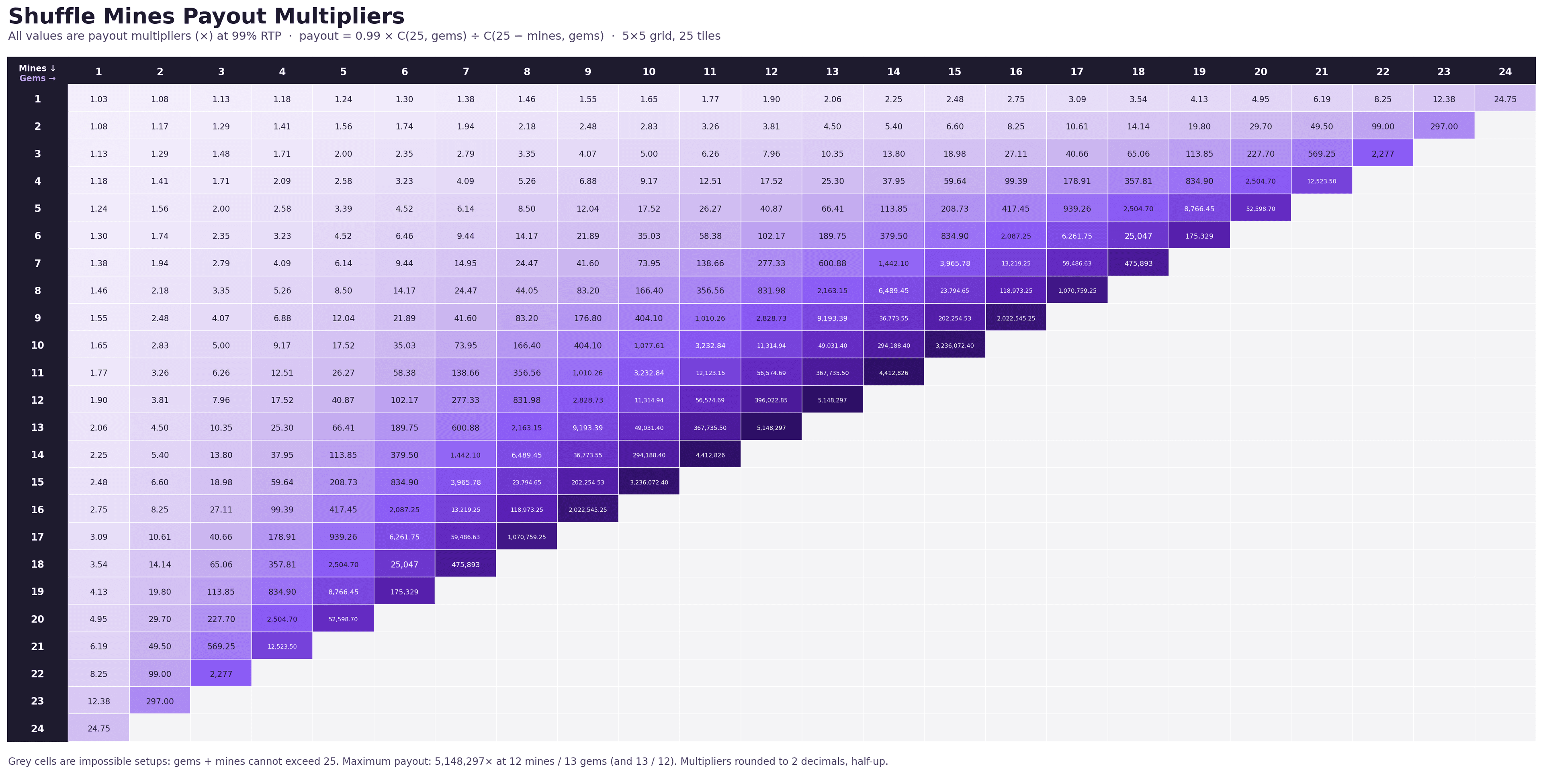
The maximum payout in Mines is 5,148,297× your bet. It comes from two mirror setups: 12 mines with 13 gems revealed, or 13 mines with 12 gems revealed. Both require clearing every safe tile on the board, and both work out to 0.99 × 5,200,300 — the fair odds of that exact feat, minus the 1% edge.
A useful symmetry hides in the full chart: swapping the mine count and gem count always produces the same multiplier. 14 mines with 11 gems pays exactly what 11 mines with 14 gems pays (4,412,826×), because the formula treats the two numbers interchangeably. This kind of transparent, formula-driven payout design runs throughout the Shuffle Originals lineup — Shuffle's in-house catalog of provably fair games.
The Full Mines Payout Table
The complete grid below covers all 300 possible setups — every mine count from 1 to 24 against every reachable gem count. Darker cells mean higher multipliers. Grey cells are impossible: gems plus mines can never exceed 25 tiles.
What Is the RTP of Mines?
Mines has a 99% RTP on every configuration — the house edge is 1% no matter how many mines you set. You can verify this directly from any row above: multiply the multiplier by the chance of reaching it and you get approximately 0.99 every time. At 5 mines and 5 gems, 3.39 × 29.18% ≈ 0.99. At 10 mines and 7 gems, 73.95 × 1.34% ≈ 0.99. This is the same rule from the calculation section running in reverse — there, the payout was the 99% return divided by the probability; here, multiplying the two back together recovers the 0.99 you started with.
That constant is worth understanding. No mine count is mathematically "better" than another — every setup returns the same 99% over the long run. What changes is the shape of the outcome: low mine counts pay small amounts often, high mine counts pay large amounts rarely. Each pick is an independent chance-based event, and no picking pattern or tile strategy changes the odds the formula sets.
Mines runs in your browser on desktop, tablet, or phone with no app needed, and if anything about a round looks off, Shuffle's support team is available 24/7 via live chat and email. New to the game itself? The how to play Mines guide walks through the rules step by step, and the Shuffle Originals guide covers the rest of the lineup.
Is There a Best Mines Strategy?
No strategy changes the math above, and it's worth being direct about why. Every tile pick is an independent chance event — the game doesn't track patterns, corners aren't luckier than centers, and past rounds have no effect on the next one. Any "winning system" you'll find promoted elsewhere runs into the same 1% edge on every cell of the chart.
What you can control is the shape of your risk, and that's a real decision even though it isn't an edge:
Mine count sets your variance. One mine at a 96% first-pick survival rate plays like a slow grind; ten mines at 60% plays like a lottery ladder. Neither is smarter — they're different experiences with identical long-run RTP. Pick the one that matches how you want a session to feel. And you don't have to commit money to find out: Mines accepts bets of 0.00, so you can run any setup at zero stake and watch how the multiplier ladder behaves before betting anything.
Cash-out discipline is the only "skill" in the game. Because you can bank your multiplier after any successful pick, the practical decision is when to stop — and deciding that before the round starts is what separates a controlled session from a chased one. A pre-set rule ("three gems, then out") will always serve you better than deciding tile by tile, because in-the-moment decisions drift toward one more pick.
Bet sizing does the rest. Whatever mine count you choose, size bets so a losing streak at that setup's survival odds is affordable. The chart's chance column tells you exactly how often each depth fails — use it.
That's the honest version of Mines strategy: variance selection, a stopping rule, and stake sizing. Anything promising more than that is selling something the formula doesn't allow.
Frequently Asked Questions
What does 1 gem pay at 24 mines?
One gem at 24 mines pays 24.75×, the highest single-pick multiplier in Mines. It's a one-in-25 shot: exactly one safe tile on the board, and the payout is 0.99 × 25.
What is the best number of mines to pick?
There is no mathematically best number — every mine count returns the same 99% RTP. Fewer mines produce frequent small wins; more mines produce rare large ones. The right setting is whichever payout shape suits you, sized within limits you're comfortable losing.
Why is the multiplier not exactly the true odds?
Each multiplier is the true odds multiplied by 0.99. The 1% difference is the house edge, applied identically to every cell in the chart. A setup with fair odds of 100-to-1 pays 99×, not 100×.
Can you cash out at any point in Mines?
Yes. After any successful pick, you can cash out at the multiplier shown for your current gem count, or continue to the next tile at the next multiplier in the chart. Hitting a mine ends the round and forfeits the bet.
Are Mines results provably fair?
Yes. Mines is a Provably Fair Shuffle Original: each round's mine placement is generated from a cryptographic seed and nonce that you can verify after the round, so outcomes can be independently checked against the multiplier chart on this page.
Mines is available on Shuffle for players 18 and over. Outcomes are determined by chance, and no strategy changes the 1% house edge — so treat every session as entertainment, not income. Shuffle's responsible gambling tools include loss limits, wager limits, and self-exclusion through Shuffle Wise, and support is available if gambling stops being fun.